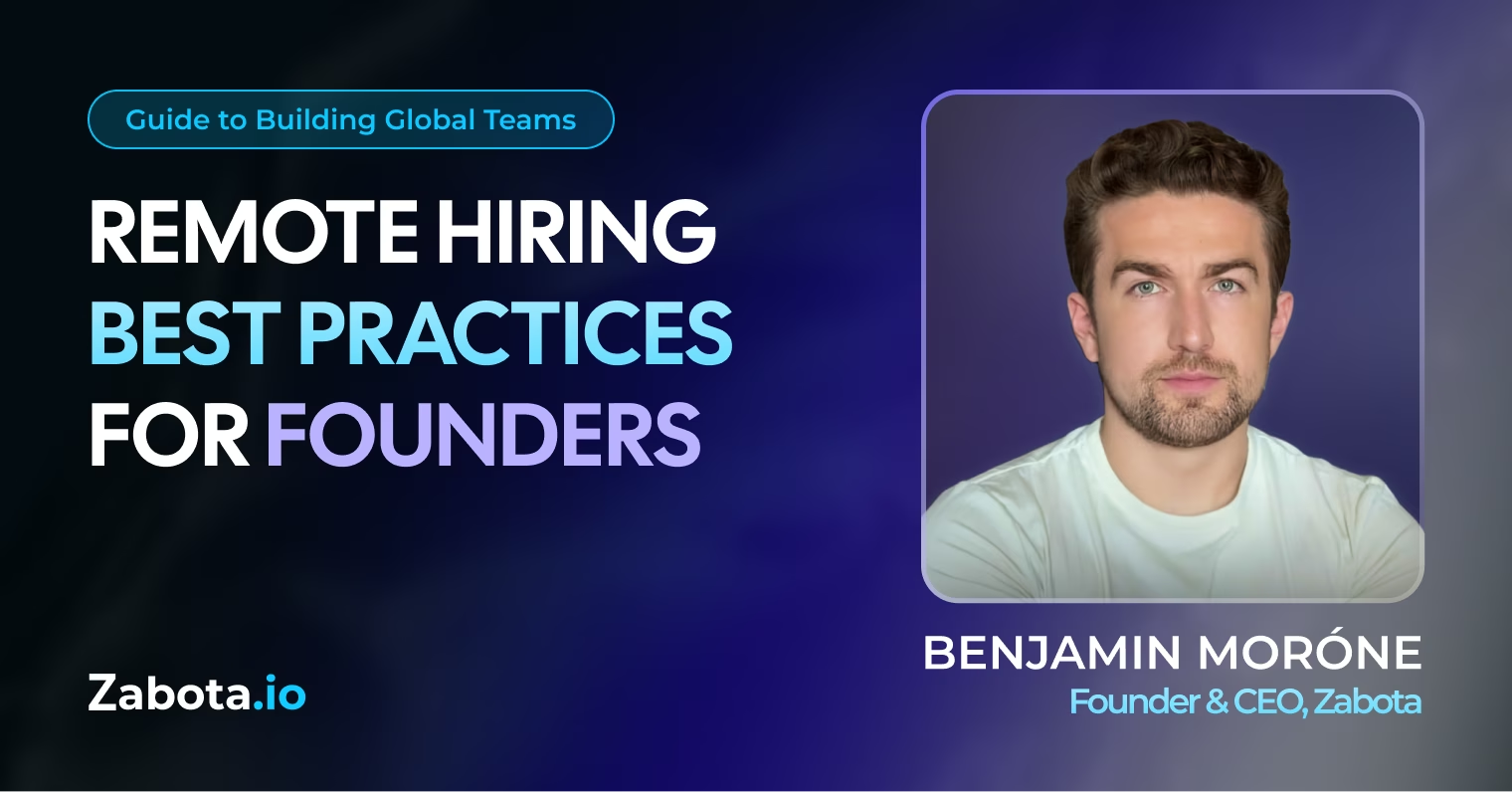
Remote hiring has fundamentally changed how founders build companies.
What used to require local talent pools now opens access to skilled operators worldwide, often at 40-60% lower costs than US equivalents. Remote hiring for founders means strategically building teams by tapping into global talent markets in LATAM and Europe.
After helping place 250+ candidates across 20+ countries and saving clients over $3.25M in payroll costs, we've distilled what actually works into a repeatable framework. Benjamin Moróne, CEO of Zabota.io, breaks down the strategic approach behind successful global hiring. Let's dive into it.
Most founders hire too early. They're drowning in work and think another person will solve it. But adding talent to broken operations just multiplies chaos.
📹 Watch the full podcast: The Operational Foundation (Before You Hire)
Benjamin Moróne calls this the "leaky bucket" concept. Pouring leads into a business with broken operations is like filling a bucket with holes. You need to patch the leaks first, operations and financials, before scaling with people.
If you hire into chaos, you create more chaos.
Before recruiting, you need Standard Operating Procedures (SOPs). Think of SOPs as the blueprint. Without them, your new hire is guessing. They can't deliver if they don't know what "good" looks like.
Key insight: If you can't document the process, you're not ready to delegate it.
Benjamin Moróne tracked his time and discovered he spent 110 hours per month on recruitment activities instead of growing the business. That's the trigger event.
Track your time for one week. Categorize tasks into:
Use a time-tracking tool like Toggl or Clockify for accurate data. Manual estimates are usually 30-40% off. If you're spending 20+ hours per week on work someone else could handle, it's time to hire.
Benjamin recommends splitting the onboarding of a new hire into two parts:
1. Company Context:
2. Role Context:
This keeps ramp time short and expectations clear.
Grab the Founder Hiring Toolkit with onboarding templates, scorecards, and exercises to get new hires productive in 30 days.
Founders usually hire backwards. They outsource sales first because it feels urgent. Big mistake.
📹 Watch the podcast: The Strategy of Delegation
Benjamin’s framework flips conventional wisdom: stay close to sales, delegate fulfillment first.
Sales represent your direct connection to the market. Every objection teaches you something about your product. Every question reveals a gap in your messaging. Outsource sales too early, and you lose that feedback loop.
Fulfillment is different. It's execution-focused and follows documented processes. Once you've proven a delivery method works, it can be delegated to someone who follows your blueprint.
Delegating fulfillment frees you to focus on strategy and revenue generation. You're not stuck in delivery weeds.
Founders often hide in fulfillment work because it feels productive. You're good at it. Clients are happy. The work is tangible.
But comfort doesn't scale.
Staying buried in fulfillment lets you avoid the harder work of building systems and managing people. Hiring forces you to stop hiding and step into leadership.
Benjamin strongly advocates against using Upwork or Fiverr for core business functions. Gig platforms work for one-off tasks. But for strategic roles, you need full-time remote employees.
Permanent remote hires create leverage. Gig workers create dependency.
Geography matters. Time zones affect collaboration, and regional talent pools have different strengths.
📹 Watch the full podcast: The Mechanics of Global Hiring
Poland, Romania, and Ukraine excel at asynchronous work requiring sustained focus.
The 6-9 hour time difference with the US East Coast creates a workflow advantage. Your European team starts their day when you're sleeping. They tackle complex projects during peak hours. You wake up to completed deliverables.
Best for:
The education systems emphasize technical rigor. Engineers from Polish or Ukrainian universities often have stronger foundational skills than Western counterparts. English proficiency is strong among professionals under 40.
Colombia, Argentina, and Mexico offer time zone alignment with the US.
Best for:
LATAM professionals operate during your business hours. No delayed responses, and you get an immediate collaboration when it matters. For a comprehensive breakdown of salary ranges, role fit, and hiring nuances across all major regions, check out our Remote Talent Map 2025: Top 10 LATAM, EU & EMEA Hotspots.
Benjamin Moróne shares a critical case study:
A grant writer named Amanda managed 65 projects in Excel. She was drowning and the obvious solution? Hire more writers.
The actual solution? Hire a Project Manager.
That PM implemented Monday.com and created workflow templates. The business scaled from one overwhelmed writer to a coordinated team of 5-6 people.
The lesson:
“When drowning in chaos, you often need someone who organizes the work, not just someone who does more of it.”
Top talent moves fast. The best candidates are off the market within 7-10 days. Benjamin’s recommended timeline:
Speed signals seriousness. Delays signal disorganization.
Zabota specializes in LATAM & EU placements with a 14-day average hire time and pre-vetted candidates ready for final interviews.
Get started in 2 steps:
1. Explore Real Results
See how founders scaled with strategic global hiring.
2. Book a Consultation
Let's discuss your next hire and build a custom sourcing plan for your business.


.png)


