Most founders think they have a training problem.
They hire someone who looks solid on paper. The resume checks out. The interview goes well. Week one starts with optimism.
When week 2 hits, you're rewriting their work. Slack is flooded with "quick questions." Client deliverables are getting delayed. By Week 4, reality sets in: this person fundamentally doesn't get it.
So you double down on training. More Looms. More documentation. More one-on-ones. Here's what that actually costs you.
According to SHRM’s research, the average cost of a bad hire equals 30% of the first-year salary. For a $60,000 hire, that's $18,000.
Let's break down what actually happens when you hire the wrong person.
Week 1-2:
10-15 hours teaching basics they should already know.
Week 3-4:
8-12 hours per week cleaning up mistakes, redoing client work, answering the same questions repeatedly.
Week 5-8:
5-10 hours per week still doing half their job while hoping training finally clicks.
Month 2-3:
You're back to square one, having burned through:
Total cost per bad hire: $30K-$50K.And that's conservative.
Here's the uncomfortable truth most founders resist: you can't train someone into taking ownership, you can't teach someone to think at your business's level, and you can't turn a task-doer into an operator.
Research from Leadership IQ found that 46% of new hires fail within 18 months. The shocking part? Only 11% fail due to a lack of technical skills.
The overwhelming majority fail because of coachability (26%), temperament (23%), or motivation (17%).
Job boards like LinkedIn Ads, Upwork, Fiverr, and Indeed usually attract volume. A-players still apply, but they're buried under 300 applications from people who interview well and collapse under real work.
You're searching for one diamond in a pile of polished rocks. And you're making that decision based on a 45-minute Zoom call.
Learn more about this in Benjamin’s LinkedIn Post.
Let's run the numbers on two hiring scenarios:
Total founder time: 80-120 hours before you even know if it'll work.
Financial cost: $8K-$15K in salary + opportunity cost of stalled growth
Total founder time: 15-20 hours total
Financial cost: One-time placement fee + salary (typically 50-60% less than US hire)
The difference?
60-100 hours back in the founder’s calendar and real leverage from day one.
Founders who consistently hire A-players follow a completely different playbook. Here's what separates them:
Job ads attract people who are looking. Headhunting finds people who are performing.
When you headhunt:
A resume tells you what someone says they did. A-player hiring systems focus on proof:
Top founders look for candidates who:
The remote hiring revolution has unlocked access to world-class talent at 40-60% of US payroll costs.
Traditional staffing agencies take 20-40% of the salary every month. That's $12K-$24K annually on a $5K/month hire. Over three years? You've paid an extra $36K-$72K for the same person.
Direct hiring with Zabota means:
After 250+ placements across 20+ countries, we've identified the markets where proven operators live:
Latin America
Argentina: Strong English, US timezone overlap
Colombia: Growing remote culture, same-zone dialing
Eastern Europe
Poland: Deep tech ecosystem, EU overlap
Romania: Enterprise-level engineering
Serbia: Strong US-facing startup scene
EMEA
South Africa: Native English, US+EU crossover
The key? Hire for mid-market rates within these regions. Learn more about the Top 10 Remote Hiring Hotspots in our blog.
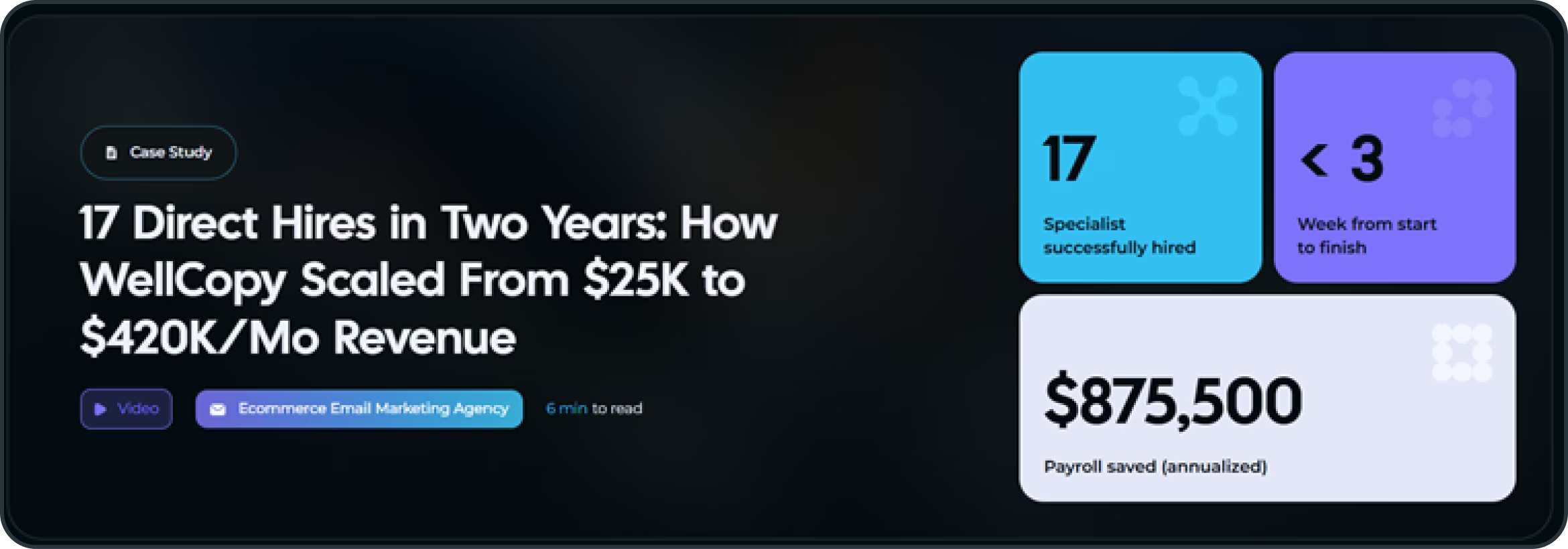
WellCopy Ecom Email Marketing Agency went from $25K/month to $420K/month in revenue after building a 17-person international team through strategic hiring.
If you want to stop wasting money on bad hires, here's the system that works:
Step 1: Define Outcomes
Instead of writing job descriptions, start writing outcome statements.
Bad: "We're looking for a marketing manager with 5+ years experience..."
Good: "In 90 days, you'll have launched our content engine, driving 500 qualified leads/month through SEO and partnerships."
Step 2: Build a Scoring System
Create a simple 100-point model:
Only engage candidates who score 70+.
Step 3: Test, Don't Interview
Skip the 5-round interview gauntlet. Instead:
You'll learn more in 3 days than in 5 interviews.
Step 4: Onboard for Independence
The best hires need:
If you're spending 10+ hours/week training them past Week 2, you hired wrong.
Spot the signs early:
If these sound familiar, here's what not to do: Don't wait it out hoping training will fix it.
After helping founders eliminate bad hires and reduce hiring costs by over $5.25M, here's what we've learned:
The difference between hiring right and hiring wrong is a system.
When you:
You don't just save money. You buy back your time and build a team that compounds.
At Zabota, we've placed 250+ hires across 20+ countries with a 14-day average timeline and 90-day replacement guarantee.
The result? Founders get A-players who deliver from week one.
The hidden cost of hiring wrong people is never just the salary you waste. It's the founder hours you lose. The growth opportunities you miss. The confidence you burn through with each failed hire.
Hiring the right talent, with the right system, eliminates the need to train in the first place.
Explore our case studies to see how founders are building high-performing teams without the hiring headaches.
Book a consultation and let us handle the headhunting so you can focus on growing your business.


.png)


