
The person who helps you get from $10K to $30K/month is different from the person who helps you get from $50K to $150K.
Not because one is better than the other. They're just good at different things.
At $15K/month, you need someone who can do 5 different tasks reasonably well.
At $75K/month, you need someone who can do 1 thing exceptionally well.
Same business. Different stage. Different hiring strategy.
This guide shows you when to make that switch - and how to do it without rebuilding your entire team.
At $10K-20K/month, generalists are the right move. You have five clients. Your processes don't exist yet. You need someone who can fill out forms, manage projects, and handle the small tasks that eat up your day.You're buying back time so you can sign more clients or actually take a weekend off.
The person doing general project management and admin work for $1,200-1,800/month? They're perfect for this stage. But there's a problem most founders miss.
What got you here won't get you there.
The same generalist approach that worked at $10K breaks completely at $25K. By $50K, it's actively killing your growth.
Around $20-25K/month, something changes. You're juggling more clients. Delivery is more complex. Client expectations are higher. And suddenly, you feel like you’re drowning in work again.
Here's what starts happening:
Work quality becomes inconsistent. Some clients love you, others are unhappy, and you can't figure out why.
You're spending more time in the business than you ever have before, despite having team members.
The worst part? You thought hiring would free up your time. Instead, you're more involved than ever.
This is the "generalist trap." And most founders respond by hiring more generalists, which only makes it worse.
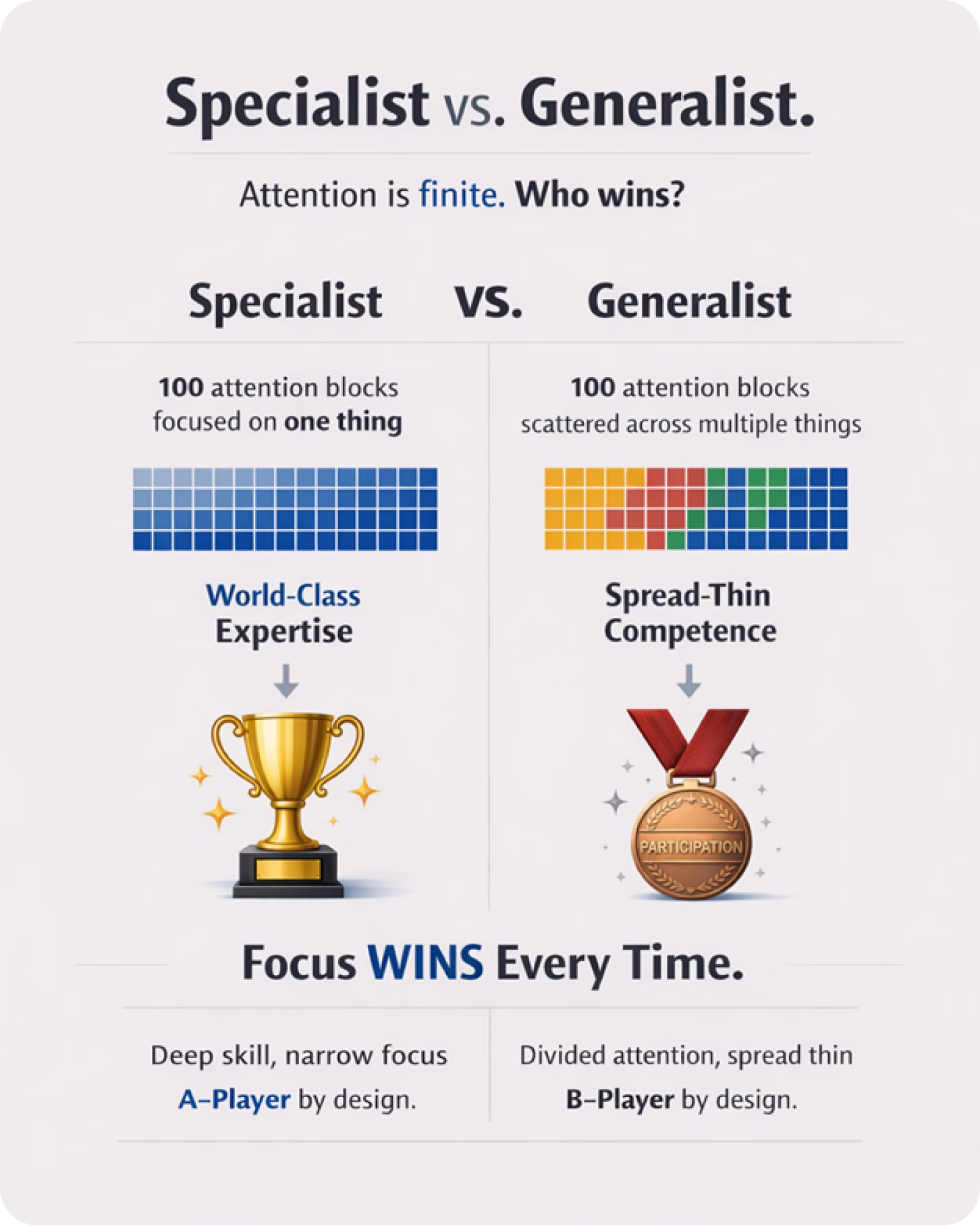
Think about your focus/attention like a store of 100 blocks per day.
Each time you do an activity you’re “spending” one of those 100 focus blocks. If 30 blocks go to endlessly scrolling social media or distractions, you've only got 70 left for work, family, and fitness.
Now imagine you're a founder doing everything: client communication, strategy, creative, deployment, monitoring, reporting.
You're spreading 20 blocks on media buying, 30 on account management, 15 on operations, and 35 on sales.
You’re spread way too thin and you can’t make real progress in any one direction.
Who wins in a competition? You - or the person who puts almost all their focus blocks into just a certain skill/area of the business? The person who puts all their focus blocks on one thing is going to win every time.
This is why you need to hire a “specialist” (someone who excels at one thing) instead of a “generalist” (jack of all trades.)
Instead of asking “Who do I need?”, ask:
1. What end results do I need?
2. Where is the bottleneck?
At $10K-20K/month: Keep it simple. You plus 1-2 generalists handling execution. You're still figuring out what works. Specialists are premature.
At $20K-50K/month: This is the critical transition point. Hire your first specialist in whatever function is currently broken. Usually, that's delivery (account manager or core executor) or client retention.
At $50K-150K/month: Build your specialist team. You need people who move specific metrics: conversion rates, client retention, and campaign performance. Roles should be clearly defined.
Past $150K/month: Hire senior specialists who design systems, not just execute tasks. You're building infrastructure now.
Hiring for tasks instead of outcomes:
You want someone who improves a specific metric, not someone who "does social media."
Expecting specialists to act like generalists:
Let them do what they're great at. If they need admin support, hire someone else for that.
Optimizing for the cheapest hire:
A $2K/month generalist who's okay at everything costs more than a $4K/month specialist who's excellent at one thing.
Skipping paid trial tasks:
Don't hire anyone without seeing them actually do the work. We run paid 2-hour trial tasks for every role. It saves us from $20K+ mistakes.
Waiting until you're drowning:
By the time you feel the pain of being understaffed, it’s too late to hire. Instead, hire when you hit 80% capacity.
Week 1: Audit the last 90 days.
Where did things break? Which clients were unhappy? What deadlines were missed?
Week 2: Identify one metric that would unlock 10x more in growth than others.
Campaign performance? Delivery speed? Pick one.
Week 3: Define the role around that outcome. Write a job description that describes the result you need. Avoid writing only tasks.
Week 4: Run interviews and paid trial tasks. Hire one specialist, then repeat the cycle.
Generalists help you start. Specialists help you scale. If your revenue is growing but the business feels heavier, not lighter - you're hiring for the wrong stage.
You just need to stop hiring the same way you did at $10K when you're now at $50K.
At Zabota, we help founders map the right roles for their current growth phase. We've helped 250+ founders place specialists who drive outcomes for their businesses.
Book a free consultation to map your next hire. We'll tell you exactly what role to hire, what to pay, and how to structure the trial task.
Related Resources from the Zabota team:


.png)


