We’ve seen founders who think tracking equals knowing.
So they install screenshot software, they watch green dots on Slack, and they keep counting hours.
Then they’re surprised when their best people quit.
Today, we talk about micromanagement and how to help founders stop checking screens and start watching their business grow.
Fast facts:
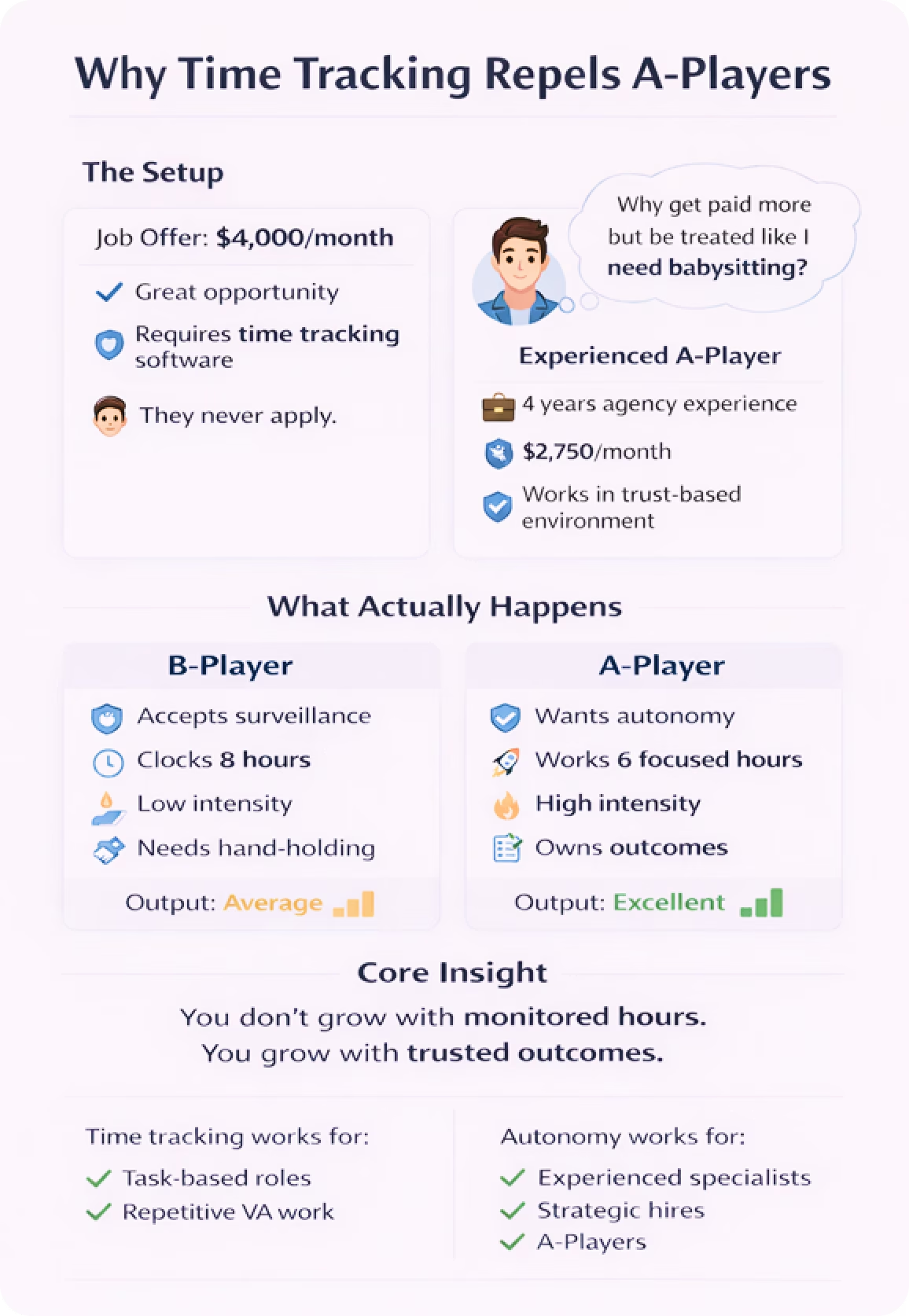
Once you install a tracking software or start micromanaging any other way, your A-players immediately start checking job boards.
These are people who manage teams, run campaigns, or talk to clients. They don’t want to feel like a teenager on a curfew.
Most people would take a lower-paying job at a company that trusts them over a higher-paying one that watches their every move. The world's largest professional association for human resource management - (SHRM)’s research on remote monitoring backs this up: excessive tracking erodes trust and drives turnover.
Think about it this way.
If you run an ad agency, your client doesn't pay you for the time you spent on their campaign. They pay you for the results you get them: more sales, more leads, better performance.
Your team works the same way.
When you track hours, you're measuring the wrong thing. Someone can sit at their desk for 8 hours and produce nothing useful. Someone else can work 6 hours and retain an unhappy client, close an upsell, or catch a campaign that's bleeding ad spend… and the list goes on.
Every full-time hire costs you roughly 160 hours per month.
Here's the simple math:
Take your employee’s monthly salary.
Divide it by 160. That's your hourly cost.
Example: An account manager earns $4,000/month. ($4,000 ÷ 160 = $25/hour)
Now ask one question: “What revenue did I actually get for those 160 hours?”
A solid account manager handles 5-8 client accounts. If each account pays you $4,000/month, that's $32,000 in managed monthly revenue.
This is the output you're buying with your $4,000.
If your account manager is only handling 3 accounts?
That's $12,000 in managed revenue.
*This example works for client-facing roles. For other positions, swap revenue for the key metric that actually matters in that role (leads generated, campaigns launched, etc.)
Your numbers will tell you everything.
The same thinking applies when you decide which roles need specialists vs. generalists.
There are actually two general structures when you organize team workflows: Flat & Pod.
Flat teams mean everyone reports straight to you, and there’s no mid-layer in the process → you become the only decision-maker for everything.
Pods fix this.
A pod is a small team, usually consisting of one leader who does strategy or team management, one executor, one specialist.
The pod owns a set of clients, they handle delivery and make decisions without you.
- Ryo Agency built 4-person pods using LATAM hires. They scaled client capacity and saved $220K per year in payroll. (See the case study)
- SteetTalk built a 6-person full creative production pod across LATAM & UK. Saved $300K per year in payroll. (See the case study)
Neither founder needs screenshots, their daily job is measuring the pod's output.
What to do when someone's numbers aren't hitting?
First, figure out why.
Ask: Do they have enough accounts to work on? Do they know what good looks like? Did you ever actually show them the standard?
If yes to all of that, run a performance improvement plan. Keep it simple:
By the end, the answer is obvious: they hit the target or they didn't. Fair for everyone. Sometimes the moment a team member is put on a performance improvement plan, they will quit and this will solve your problem with underperformance.
At Zabota, we headhunt operators who are used to working without hand-holding. People who've been in agencies and fast-moving companies before.
We vet for ownership mindset.
Then we deliver 3 handpicked candidates in 14 days. No ongoing fees or monthly markups.
Book a free consultation, and let’s map the right role, salary range, and the right targets for your next hire.
Related Resources:
• The Hidden Cost of Hiring Wrong People
• Remote Hiring Best Practices for Founders
• When to Move From Generalists to Specialists
• Zabota Case Studies


.png)


